RoHS and REACH Compliance for Custom Machined Metal Parts
EU-bound machined parts often need more than material and dimensional approval. Buyers may also need RoHS or REACH declaration support that matches the released material, finish stack and downstream product use.
The review path below explains what those requests usually mean for custom machined metal parts, where compliance review often appears, and how to define the declaration package cleanly during RFQ. If the order already needs statement support, use the RFQ upload workflow to name the destination market, coating details and requested declaration scope up front.
For REACH-controlled projects, buyers should flag whether the review needs an SVHC statement, candidate list screening, SCIP-related supplier data, or a broader restricted substances declaration tied to the released material and finish stack.

RoHS and REACH requests usually start with the product context, not only the metal grade
Compliance pages often explain the regulations but stop short of helping the buyer package the request. On custom machined parts, the real question is usually which declaration is being requested, what part of the build creates risk and what document path should be defined before routing begins.
For many projects the review goes beyond the base alloy. Finish choices under surface finishing, customer-selected plating, powder coating, adhesives, seals, inserts and secondary materials can change the declaration review scope for the final part package.
What buyers need clarified
Whether the request is for RoHS, REACH, source-material documentation or a combined declaration package.
Why RFQ timing matters
The declaration path depends on the finished part configuration, so market and finish details should be stated before machining and coating routes are fixed.
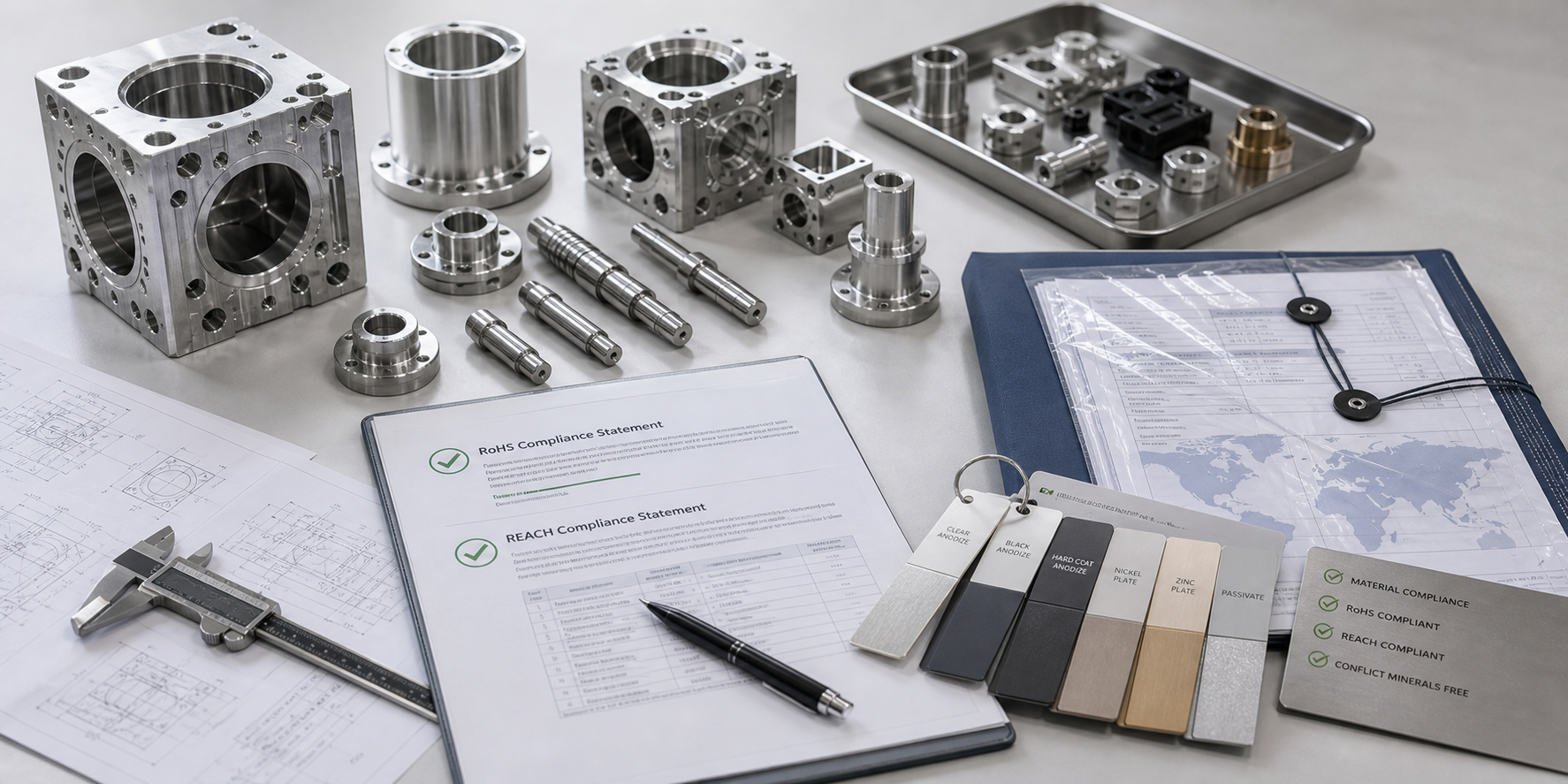
Which document does the buyer actually need?
Declaration support, source documentation and inspection evidence are not the same thing. Buyers should be able to separate them quickly.
| Document type | What it supports | When buyers usually request it |
|---|---|---|
| RoHS statement | Hazardous-substance restriction support tied to the supplied part configuration and customer requirement | EU-bound assemblies, electronics-linked programs or supplier onboarding requiring RoHS declarations |
| REACH statement | Supply-chain declaration support around regulated or communicated substances relevant to the requested part package | EU sourcing workflows, substance-communication reviews or customer declaration packages |
| Certificate of Conformance (C of C) | Order-level statement that the supplied parts were produced to the agreed drawing, revision, purchase order and selected document requirements | Projects needing shipment-level confirmation alongside RoHS, REACH or inspection paperwork |
| Material certificate | Base material identity, lot linkage and source-document path | Projects needing lot traceability or grade-backed sourcing support |
| Inspection report | Measured dimensional acceptance for selected or controlled features | Tolerance-sensitive parts, first-piece release or buyer inspection packages |
If the order needs both compliance support and lot-linked source records, combine this path with material certificates and traceability rather than treating the declaration as a substitute for source documentation.
Where compliance risk usually appears on custom machined parts
The risk review is usually less about the part name and more about the combination of material, finish and secondary items that define the shipped configuration.
Quick difference: RoHS, REACH and material certs
| Type | Primary purpose |
|---|---|
| RoHS | Supports hazardous-substance restriction requests relevant to the supplied part configuration |
| REACH | Supports supply-chain substance communication requests tied to the delivered part package |
| Material cert | Supports source-material identity and lot-linked documentation |
What to name in the RFQ for RoHS or REACH support
A declaration-controlled order should be defined before machining, finishing and packaging paths are locked.
- Destination country or customer compliance standard
- Base material grade and any approved alternates
- All requested finishes, coatings or plating processes
- Non-metal inserts, seals, bonded items or assembly additions
- Requested statement type and required submission timing
- Whether the same order also needs FAI, inspection support or material certs
A clear RFQ note helps the supplier review the full part package instead of trying to reconstruct the declaration scope after routing has already started.
When buyers usually request declarations
- EU-bound products needing supplier compliance documentation
- Programs where plating, coating or secondary materials must be reviewed
- OEM onboarding packages with document-controlled purchasing requirements
- Assemblies where the machined part supports electronics or regulated end products
- Orders combining declaration support with material or inspection documents
The declaration request is usually strongest when the buyer already knows the end-market path and finish package, which is why those details belong in the RFQ.
Frequently asked questions
What is the difference between RoHS and REACH for machined parts?
RoHS is commonly used for hazardous-substance restriction in electrical and electronic equipment programs, while REACH requests often relate to substance communication and supply-chain declaration support. Some buyers need one, some need both.
Are machined metal parts automatically covered just because the base metal is common?
Not always. The base metal matters, but plating, coatings, inserts, seals and other secondary materials may change the declaration review scope.
Is a material certificate the same as a RoHS or REACH statement?
No. A material certificate supports source-material identity and lot linkage, while RoHS or REACH statements support a compliance declaration workflow tied to the supplied part configuration and buyer requirement.
Do anodizing, plating or coatings affect declaration requests?
Yes. Finishes are often where declaration review becomes more important. That is why the RFQ should list the exact finish package instead of adding it later.
When should the buyer request the compliance statement?
The request should be made during RFQ, before routing and finishing plans are fixed. That gives the supplier the right review path for materials, finishes and secondary items.
What should be uploaded for a compliance-controlled machining RFQ?
Upload the drawing or model, material grade, finish or plating specification, destination-market context and the requested declaration type. Add any linked requirements for material certs, FAI or inspection reports in the same RFQ package.
Submit the compliance requirement before the order is routed
Send the drawing or CAD model together with the material grade, finish stack, destination-market note and requested declaration package. If the order also needs traceability or inspection support, define the document scope in the same RFQ path from the start.