CNC TURNING SERVICES
CNC Turning Services for Shafts, Bushings and Cylindrical Metal Parts
Our custom CNC turning services support prototype, pilot and repeat low-volume supply for custom turned metal parts. Great Material quotes shafts, bushings, spacers, fittings, pins and other cylindrical parts with threads, grooves, bores, cross holes, finish requirements and documentation needs.
For projects that combine round geometry with fit-critical diameters, concentric features or thread details, the RFQ package should clearly define drawing notes, inspection expectations and secondary machining needs. Buyers comparing a CNC turning service supplier or CNC lathe services partner should also identify secondary machining and documentation scope before review. For mixed-process projects, see our CNC machining services and broader custom metal parts capabilities.
Best Fit for Turning RFQs
- Stepped shafts, sleeves and spacers
- Threaded fittings, adapters and pins
- OD and ID critical dimensions
- Grooves, reliefs and bearing-seat features
- Runout, concentricity or finish callouts
- Live-tooling parts with flats or cross holes
Send the drawing with material, quantity, thread standard, finish and inspection-document needs for faster quote review, especially when CNC turning for shafts or CNC turning for bushings is being compared across suppliers.
Part Families
Shafts, bushings, spacers, sleeves, threaded fittings and pins.
Feature Focus
Grooves, threads, bores, chamfers, reliefs, flats and cross holes.
Common Metals
303, 304, 316, 17-4 PH, 1018, 1045, 4140, 6061, brass and copper.
Inspection Priorities
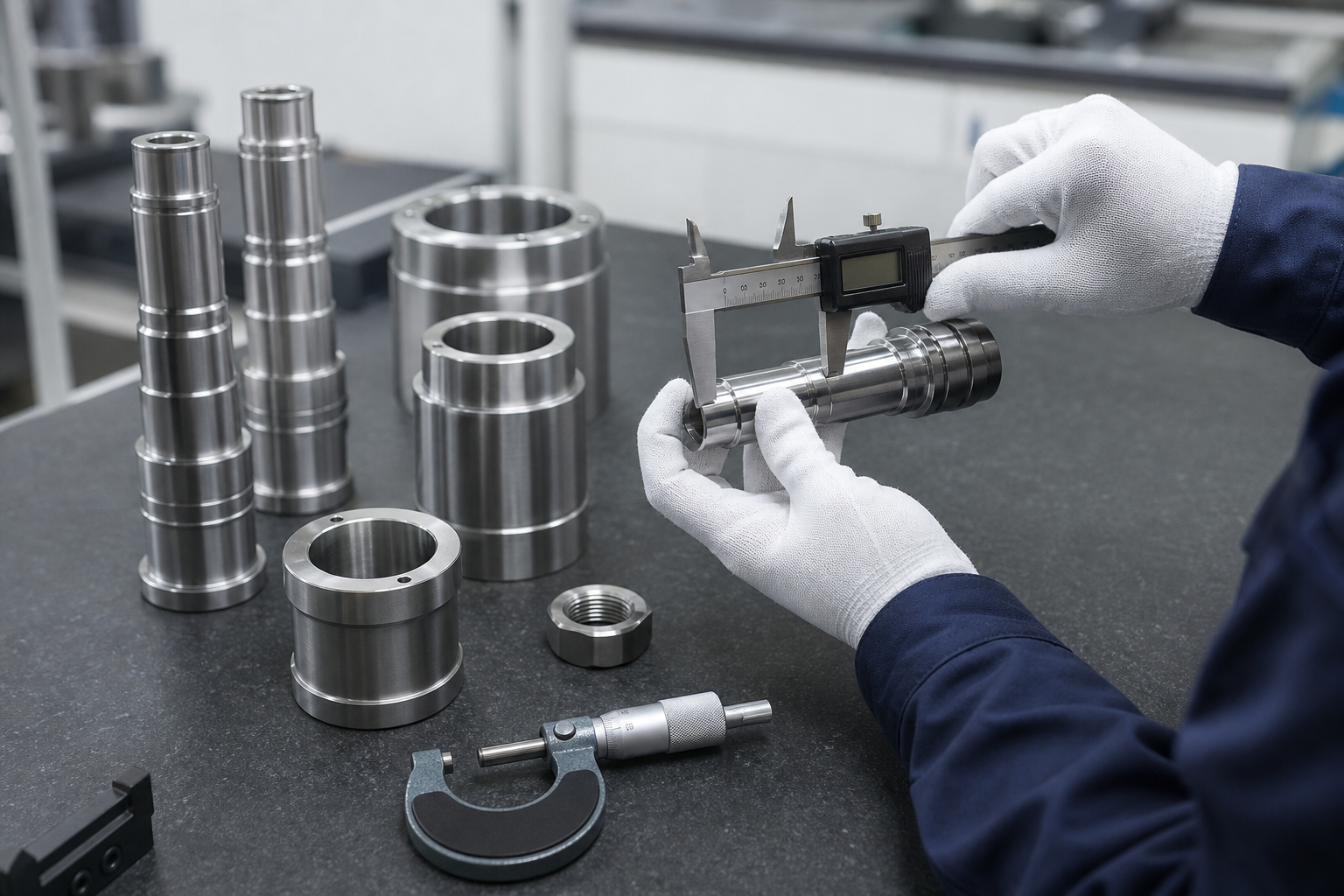
Diameter fits, concentricity, runout, thread checks and surface finish.

Where CNC Turning Fits in a Metal Part Program
Turning is usually the best starting process when the part is rotationally symmetric and the most important dimensions are outside diameter, inside diameter, step lengths, thread locations or sealing surfaces. It is often the more efficient path for shafts, bushings, collars, pins and fittings than forcing those features through a milling-first route. Precision CNC turning becomes especially important when sealing faces, bearing diameters, concentric features or thread quality drive part function.
When a component also needs flats, cross holes or slots, the quote should still begin with the turning logic and then account for live tooling or secondary machining. For parts dominated by prismatic faces and pocket work, see our CNC milling services page.
Best turning-led parts
Round components where diameter control and rotational alignment drive function.
Mixed-feature parts
Turned geometry plus holes, flats, slots or wrench features that affect route and quote.
Turned Part Family and Feature Fit Matrix
This matrix is meant to shorten RFQ back-and-forth by showing which features are straightforward turning work and which ones usually trigger secondary operations or closer review.
| Part family | Typical features | Quote notes that matter |
|---|---|---|
| Shafts and axles | Stepped diameters, bearing seats, grooves, threaded ends | Call out fit-critical diameters, runout, concentricity and finish on sealing or bearing surfaces |
| Bushings and spacers | OD/ID control, shoulders, chamfers, reliefs | Identify wall thickness sensitivity, press or slip fit expectations and any burr-sensitive edges |
| Fittings and adapters | Threads, sealing faces, wrench flats, bores | Define thread standard, sealing surface finish and whether flats are turned, milled or broached |
| Pins and dowel-style parts | Simple diameters, chamfers, tapped ends, grooves | Clarify hardness, finish protection and diameter tolerance distribution across length |
| Live-tooling components | Cross holes, flats, slots, off-axis details | Show secondary features clearly so route, setup count and inspection scope can be quoted correctly |
When Turning Is Better Than Milling
Use turning first when
- The core geometry is round or stepped around a central axis
- OD, ID or coaxial relationships control function
- Threads, grooves and chamfered ends dominate the design
- Surface finish matters on cylindrical or sealing faces
Escalate review when
- Multiple cross holes or flats change the setup path
- Long slender shafts raise deflection or straightness concerns
- Thread quality and sealing surfaces must be documented
- The part mixes turned geometry with large milled faces or pockets
If the part starts as a turned blank but ends as a mixed-process component, the quote should still capture the turning-led dimensions separately from the secondary machining scope. That keeps routing, inspection and finish planning cleaner across the full CNC machining workflow.
Materials, Finishes and Documentation Planning
| Topic | Typical planning points |
|---|---|
| Materials | 303, 304, 316, 17-4 PH, 1018, 1045, 4140, 6061, brass and copper are common depending on corrosion, strength, conductivity and fit needs. |
| Finish options | Passivation, anodizing, black oxide, bead blasting, protective oil and plating requests should be tied to material and surface function. |
| Inspection focus | Diameter fits, concentricity, runout, thread checks, groove widths and surface finish are the most common turning-driven controls. |
| Documents | Add material certs, dimensional reports or FAI needs to the RFQ so documentation scope is aligned before production starts. |
Finish selection often affects both appearance and dimensional behavior. If your project also needs downstream coating or cosmetic work, use the RFQ notes field to connect the turning page with the broader quote package. This keeps custom CNC turning and follow-on processing aligned before production starts.
RFQ Inputs That Prevent Requotes
- Fit-critical diameters: mark the OD and ID dimensions that affect assembly or motion.
- Runout and concentricity: specify where rotational alignment matters instead of burying it in general notes.
- Thread details: include thread standard, handedness, depth and engagement length.
- Feature transitions: call out grooves, undercuts, reliefs, sealing lands and chamfer requirements clearly.
- Secondary operations: show flats, cross holes or slots so the route can be quoted correctly.
- Documents: request material certs, dimensional report or FAI at RFQ stage when required.
For assemblies that mix turned and non-turned parts, combine this information with your broader custom metal parts scope so the quote captures the full build intent.
CNC Turning Services FAQ
What parts are best suited to CNC turning?
Shafts, bushings, spacers, fittings, sleeves, pins and other cylindrical parts are the most common turning applications, especially when diameter control and concentricity matter.
Can turned parts include flats, holes or slots?
Yes. Those features usually require live tooling or secondary machining, so they should be shown clearly on the drawing instead of left to general notes.
What should I include in a turning RFQ?
Include material, quantity, fit-critical OD and ID dimensions, thread standards, finish requirements, inspection-document needs and any runout or concentricity callouts.
When is turning a better choice than milling?
Turning is usually more efficient when the part is mainly rotational around one axis and the functional geometry is dominated by diameters, bores, threads, grooves or cylindrical sealing surfaces.
Can I request inspection reports or material certificates?
Yes. Add those requirements in the RFQ so quote review covers both the part geometry and the documentation package before production starts.
Ready to quote custom CNC turned parts?
Upload the drawing or 3D model with material, thread details, finish and inspection requirements. If the project also includes milled or non-round parts, we can review it through the same RFQ path while keeping the turning route clear for your CNC turning service supplier review.