5-Axis CNC Machining Services for Complex Metal Parts
5-axis CNC machining services, also searched by buyers as 5 axis CNC machining services or multi-axis CNC machining services, are not the right answer for every part. They become the right answer when complex geometry, angle access, surface continuity, single setup control or fixture reduction matter enough that standard 3-axis routing creates avoidable fixtures, secondary setups or weaker feature control.
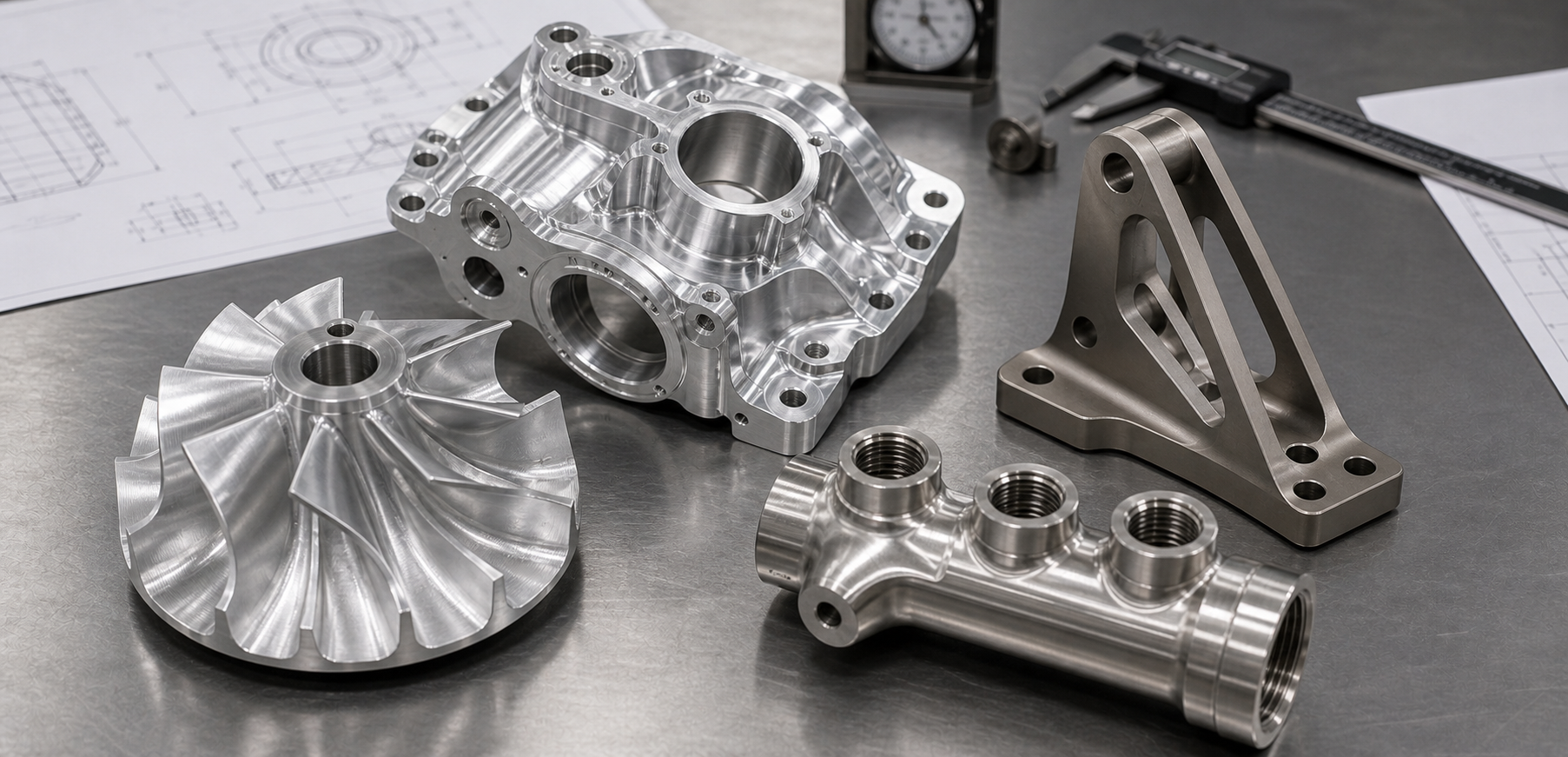
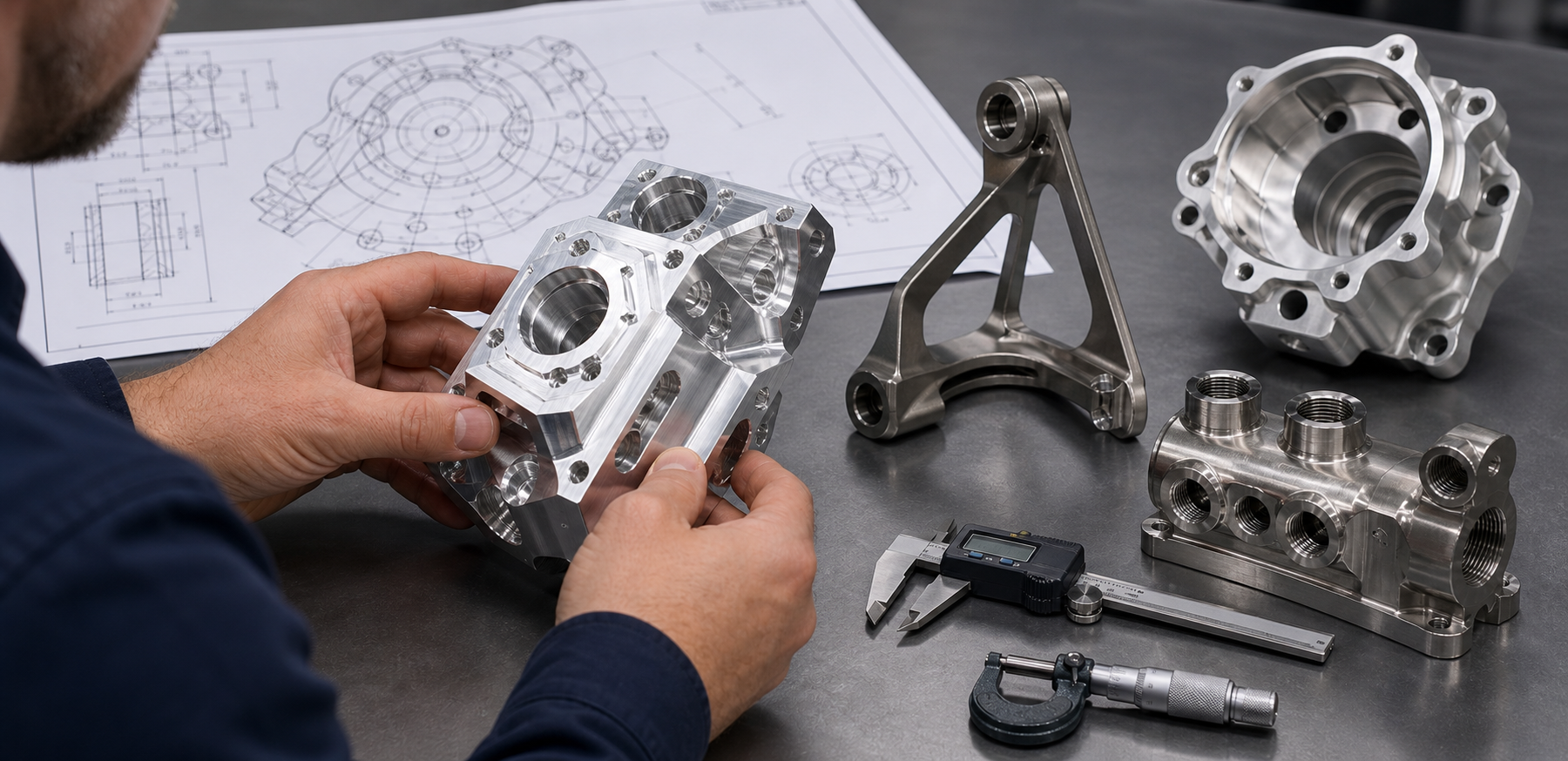
Great Material supports engineers and buyers reviewing complex CNC machined parts such as manifolds, impeller-style parts, turbine blade style contours, contoured housings, undercuts, angled holes and other multi-face metal components before RFQ submission. It explains when 5 axis machining services create a cleaner route, how indexed 5-axis or 3+2 machining differs from continuous or simultaneous 5-axis, what materials and finishes fit the process, and what to include when sending a complex-part quote package. If the project is less about geometry complexity and more about tighter dimensional control, connect this review with 5 axis precision machining and quality control and inspection.
What 5-axis review helps you decide
- Whether the part truly needs 5-axis or can stay on a simpler route
- Which features usually justify 3+2 machining, indexed 5-axis, continuous 5-axis or simultaneous 5-axis review
- How fewer setups affect surface continuity, angle access and datum transfer
- Which materials, finishes and inspection notes should be paired with the RFQ
- What to upload so a complex part can be reviewed cleanly the first time
| Best for | Complex multi-face housings, manifolds, impeller-like parts, angled holes, contour-heavy components and parts where fixture reduction improves the route |
| Primary CTA | Review complex part |
| Related pages | Precision machining, milling, custom metal parts, inspection, FAI and RFQ upload |
Use 5-axis when geometry and setup chain are the real problem
Many parts are labeled complex when the real issue is only tolerance or material difficulty. A true 5-axis candidate usually has multi-angle access, contoured surfaces, undercuts, deeper cavities with difficult tool entry, datum stability concerns, collision risk around short tools or visible and functional geometry that benefits from fewer re-clamps.
That means the process choice should be reviewed alongside CNC milling services, custom metal parts scope, finish planning and the final inspection path. If the part mostly needs tight positional control on simpler geometry, a precision route may matter more than full simultaneous motion.
- Use 5-axis when the part gains from fewer setups and better feature access
- Use indexed 3+2 when the geometry needs multiple approach angles but not constant simultaneous motion
- Use custom 5 axis machined parts review when the setup chain is shorter than a stack of special fixtures and the shorter setup chain protects feature relationships
- Use 5 axis CNC milling services when rotary access gives milling tools a cleaner approach to multi-face features
- Use continuous 5-axis when curved or blended surfaces need uninterrupted tool orientation
- Send the model, drawing and critical-surface notes together when you request a quote
Feature classes that usually justify 5-axis review
These are the feature types that most often move a part out of standard milling and into a 5-axis review conversation.
Parts with critical geometry distributed across several faces, where repeated re-clamping increases alignment risk and slows machining.
Angled holes, internal pockets, side-entry features and wrapped geometry that are hard to reach cleanly with a simpler setup chain.
Impeller-like, ergonomic, aerodynamic or fluid-path surfaces that benefit from smoother tool orientation and fewer transition marks.
Visible parts where blend quality, surface continuity and reduced witness lines matter to the final product appearance.
Thin-walled or complex parts where fixture complexity itself becomes a major source of cost, distortion or routing risk.
Aerospace-style, automation, medical and advanced equipment components where process cleanliness can justify the more advanced route.
3-axis vs 3+2 vs continuous 5-axis decision matrix
This is the core selection question on many RFQs. The goal is not to force every difficult part into continuous 5-axis, but to match the route to the geometry and the cost logic.
| Route | Best for | What it improves | Limits | Typical RFQ signal |
|---|---|---|---|---|
| 3-axis machining | Flat-sided geometry, top-access pockets, standard profiles and simpler prismatic parts | Strong baseline cost efficiency for simpler geometry | Requires more setups for multi-angle features and side access | Most critical features are still reachable from standard orientations |
| 3+2 indexed machining | Multi-face parts with angled features that can be machined from indexed positions | Fewer fixtures, better angle access and cleaner face-to-face control | Does not solve every contour or continuous blend requirement | The part needs multiple approach angles but not full simultaneous motion across the cut |
| Continuous / simultaneous 5-axis | Complex contours, blended surfaces, impeller-style forms and geometry that benefits from constant tool orientation | Improves tool access, surface continuity and route cleanliness on truly complex parts | May add cost if the geometry does not truly need it | The part includes contoured surfaces, tight angle transitions or hard-to-reach areas that are inefficient on indexed setups |
The cost logic is not only machine rate
5-axis machining is often judged too early by hourly rate alone. In practice, the route can still be the better commercial choice when it removes fixture layers, shortens setup changes, reduces manual repositioning, improves surface access or avoids secondary machining steps on the same part.
That is why the review should start from the geometry and the setup chain, not from a generic assumption that more axes always mean unnecessary cost. If the part also needs controlled finish and visible surface quality, connect this review with surface finishing for CNC parts, an inspection report request and the final inspection plan.
5-axis tends to earn its cost when
- the part would otherwise need several fixtures or many reclamps
- surface continuity matters across blended geometry
- angle access or tool reach is limiting the route
- critical geometry sits across multiple faces or compound angles
- the part value is high enough that cleaner routing reduces total risk
Materials, finishes and inspection should stay in the same review loop
Complex geometry rarely stands alone. Material stability, post-machining finish, and the required evidence path can change how the route should be planned before the quote is finalized.
| Review area | What to decide early | Related page |
|---|---|---|
| Material route | Whether the part is aluminum, stainless steel, titanium or another alloy with different stability, cost and tool-access implications for 5 axis metal machining | Aluminum machining and stainless steel machining |
| Finish-sensitive surfaces | Which visible or fit-critical areas need protection, masking or final recheck after finishing | Surface finishing |
| Inspection scope | Whether the part needs dimensional report, sample evidence or a deeper first-build review path | Quality control and FAI |
| Drawing and release documents | What needs to be stated in the RFQ so process routing and document release stay aligned | RFQ upload and material certs |
What to upload for a clean 5-axis RFQ review
The fastest way to slow down a 5-axis quote is to send only a model with no feature priorities, no finish notes and no indication of which surfaces actually control performance. Complex parts need a more explicit handoff than standard prismatic parts.
- 3D model and controlled drawing, not one or the other alone
- Material and preferred route if already known
- Critical multi-face features, blend zones, angle-sensitive areas and visible surfaces
- Finish requirements, masking notes and any post-finish recheck concerns
- Document requirements such as dimensional report or first-build inspection evidence
Complex-part RFQ checklist
| Geometry | Call out contoured zones, deep cavities, angled features and wrapped surfaces |
| Feature priority | Mark the surfaces, datum stability requirements and datums that actually control function or visible quality |
| Inspection package | State whether the RFQ needs an inspection report, FAI or critical-feature report for aerospace components, medical components or other high-value parts |
| Material | Name the alloy and state if material choice is still open for review |
| Finish | Add coating, anodizing, masking or cosmetic-face notes up front |
| Documents | State report, cert or first-build evidence requirements during quotation |
Frequently asked questions
When should I use 5-axis CNC machining?
Use 5-axis when the part benefits from fewer setups, better angle access, contoured tool orientation or cleaner multi-face control than a simpler milling route can provide.
What is the difference between 3+2 and continuous 5-axis?
3+2 indexes the part to different fixed angles before cutting, while continuous 5-axis keeps tool orientation moving during the cut. Many complex parts only need indexed motion, not full simultaneous machining.
Is 5-axis machining always more accurate?
Not automatically. It is often more effective when accuracy depends on reducing re-clamps or preserving geometry across several faces. Simpler parts can still be handled well on other routes.
Which parts are common 5-axis candidates?
Typical candidates include impeller-style parts, manifolds, contoured housings, multi-angle brackets, fluid-path components and other parts with distributed geometry across several faces.
Does 5-axis machining reduce cost?
It can reduce total process cost when it removes fixtures, setup changes or secondary operations. On geometry that does not need it, it may simply add unnecessary process complexity.
What should I send for a 5-axis machining quote?
Send the model, controlled drawing, material, finish notes, critical surfaces, quantity and any required inspection or certification documents so the route can be reviewed correctly.
Send the complex part before the routing gets simplified too far
If the part has wrapped geometry, difficult angle access, deep cavities, undercuts, blended surfaces or finish-sensitive visible areas, send it through the RFQ page with the model, drawing and feature priorities. That makes it easier to choose between 3-axis, indexed 5-axis, 3+2 machining and continuous 5-axis before quoting the wrong route.