Custom Metal Brackets and Mounting Components
Custom brackets are usually purchased for a very specific job: locating a part, carrying a load, holding alignment, creating a mounting plane or bridging one assembly to another. Buyers care less about the word bracket than the details behind it: material, thickness, hole pattern, slots, gussets, finish, assembly access and what process makes the part practical to produce.
Review quote-ready custom metal brackets, custom mounting brackets and machined mounting components for automation, industrial equipment, enclosures, fixtures and mechanical assemblies. Compare common bracket families, when CNC machining is the better route, how materials and finishes affect the part and what should be uploaded when you need a similar component quoted. This page is built for buyers comparing custom aluminum brackets, custom steel brackets, CNC machined brackets and precision machined brackets from a practical mounting and assembly standpoint. For broader support, connect with custom metal parts, CNC machining services and precision CNC machining.
Bracket RFQ essentials
- Bracket type: L, U, Z, gusseted support, mounting plate or custom geometry
- Material, thickness and whether the part is cosmetic, structural or alignment-critical
- Critical hole pattern, slotted holes, threaded holes, clearance holes, perpendicular faces and any fastening hardware requirements
- Any bend-driven features versus machined features such as bosses, pockets or counterbores
- Finish requirement, environment exposure and quantity stage: prototype, pilot run or repeat supply
- Any need for FAI, dimensional report or finish support
| Primary CTA | Upload bracket drawing |
| Best fit | Buyers sourcing machined or mixed-feature brackets for OEM assemblies |
| Related pages | CNC machining, aluminum and stainless materials, finishing and RFQ support |
Bracket sourcing should sort geometry, process and risk quickly
Engineers and buyers need more than bracket photos and a quote button. A useful bracket sourcing path should clarify what type of bracket is being sourced, which features are simple and repeatable, which ones change the manufacturing route and what information matters most before pricing or DFM review starts.
That is especially important for mixed search intent. Some bracket programs are best handled as bent sheet-metal parts. Others are better as machined aluminum or stainless components because the part needs precise hole relationships, rigid locating faces, thick sections, counterbores, slots, tapped features or gusseted geometry cut from billet or plate.
- Simple mounting tabs and bent angles are often quoted by thickness and formed geometry
- Machined brackets are often chosen when slotted holes, threaded holes, clearance holes and reference faces must hold a tighter relationship
- Reinforced or gusset-style parts may need a more rigid billet or plate-based solution
- Exterior finish and environment exposure often affect the material choice as much as the geometry
Choose the bracket route before comparing suppliers
Many Google results push one route first. Buyers usually need both. A better supplier conversation starts by deciding whether the job is closer to custom bracket fabrication from formed sheet stock or a CNC program for custom metal mounting brackets with tighter geometry control.
| Decision point | Machined bracket route | Formed / fabrication route |
|---|---|---|
| Geometry type | Better for pockets, bosses, counterbores, tapped holes and multi-face locating features | Better for straightforward bends, flanges and simple hole patterns |
| Tolerance priority | Preferred when hole-to-face relationships and perpendicularity drive assembly fit | Often suitable when bend variation is acceptable and the bracket is less datum-critical |
| Volume stage | Common for prototype and pilot custom mounting brackets without tooling delay | Common when formed geometry repeats at stable production volumes |
| Typical buyer concern | Precise alignment, thread quality, machined datum faces and inspection burden | Tooling, bend sequence, cosmetic faces and flat-pattern efficiency |
Typical custom bracket and mounting component families
Bracket buyers usually want to map their design to a familiar family first. That makes the quoting discussion much faster.
| Bracket family | Typical role | Common materials | What usually matters most |
|---|---|---|---|
| L brackets and angle supports | Create a basic mounting plane or hold two faces at ninety degrees | Aluminum, stainless steel, carbon steel | Hole pattern accuracy, thickness, load path and finish exposure |
| U brackets and capture brackets | Hold sensors, rollers, shafts or mounted subassemblies between two walls | Aluminum and stainless steel | Parallel wall control, internal width, hole coaxiality and assembly clearance |
| Z brackets and offset mounts | Shift one mounting face away from another to clear nearby hardware or panels | Aluminum, stainless steel, formed steel | Offset stack-up, flatness after forming or machining and access for fasteners |
| Gusseted support brackets | Increase stiffness for heavier assemblies or vibration-prone structures | Machined aluminum, stainless steel, welded or formed steel | Rib geometry, load direction, fastening base and stress concentration control |
| Mounting plates and interface tabs | Provide a clean interface for components, covers or subassemblies | Aluminum, stainless steel, carbon steel | Slot location, edge quality, countersinks, cosmetics and finish compatibility |
When CNC machining is the better bracket route
Not every bracket should be machined. But machining becomes the stronger option when the bracket needs controlled relationships, heavier sections or details that are not efficient in a simple formed part.
Material and finish logic for mounting brackets
Competing pages often list aluminum, stainless steel and steel without telling the buyer what changes with each choice. Bracket programs usually need a simpler, decision-ready answer.
- Aluminum CNC machining is often selected for lighter assemblies, clean cosmetic finishing and good machinability in prototype or low-volume bracket programs
- Stainless steel machining is often preferred when the bracket sits in a corrosive environment or needs a stronger, more rugged feel
- Carbon steel brackets are common when cost and stiffness matter more than corrosion resistance, especially if a painted or powder coating finish is planned
- Surface finishing for CNC parts should match environment, appearance, wear and whether threads or locating faces need masking attention; common choices include aluminum anodizing, stainless steel passivation and powder coating for steel brackets
If the bracket mates to visible hardware, enclosure panels or corrosion-sensitive assemblies, note that at RFQ stage so finish selection supports the real use condition. That is especially useful when comparing custom aluminum brackets against custom steel brackets for the same assembly package.
Bracket DFM and cost drivers
- Very thick stock paired with small internal radii or narrow slots
- Hole patterns referenced from several faces without clear datums
- Thin unsupported ribs or long gussets that increase chatter risk
- Many tapped holes, counterbores or multi-side operations on a small part
- Cosmetic outer faces combined with functional dimensions on the same surfaces
- Inspection requirements such as first article inspection, dimensional reports or inspection review
If a bracket must hold critical perpendicularity, locate a sensor precisely or repeat a fastener pattern across multiple mating parts, flag those points early so the quote reflects the actual inspection burden.
What a better bracket RFQ package includes
Top-ranking pages ask for a quote. Fewer tell the buyer what makes the quote usable. A strong RFQ helps the mounting components manufacturer judge process fit, inspection scope and finish risk on the first review.
- CAD model or drawing with overall envelope, thickness and revision status
- Datum strategy for hole patterns, slots, mounting faces and any perpendicularity callouts
- Hardware notes for threaded holes, inserts, PEM-style fasteners or clearance expectations
- Material grade, finish request and whether the part is visible, corrosion-exposed or load-bearing
- Quantity split by prototype, pilot and repeat production if the custom bracket fabrication plan will evolve
- Inspection-document request such as FAI, dimensional report or material certificate path
Typical questions before quoting precision machined brackets
- Does the bracket align a sensor, motor, cover or enclosure wall?
- Are all holes equally important, or only a few assembly datums?
- Should finish be cosmetic, corrosion-focused or thread-safe?
- Can any features move from machining to forming without changing function?
- Will the part be quoted alone or with a larger assembly of housings, shafts or fixture plates?
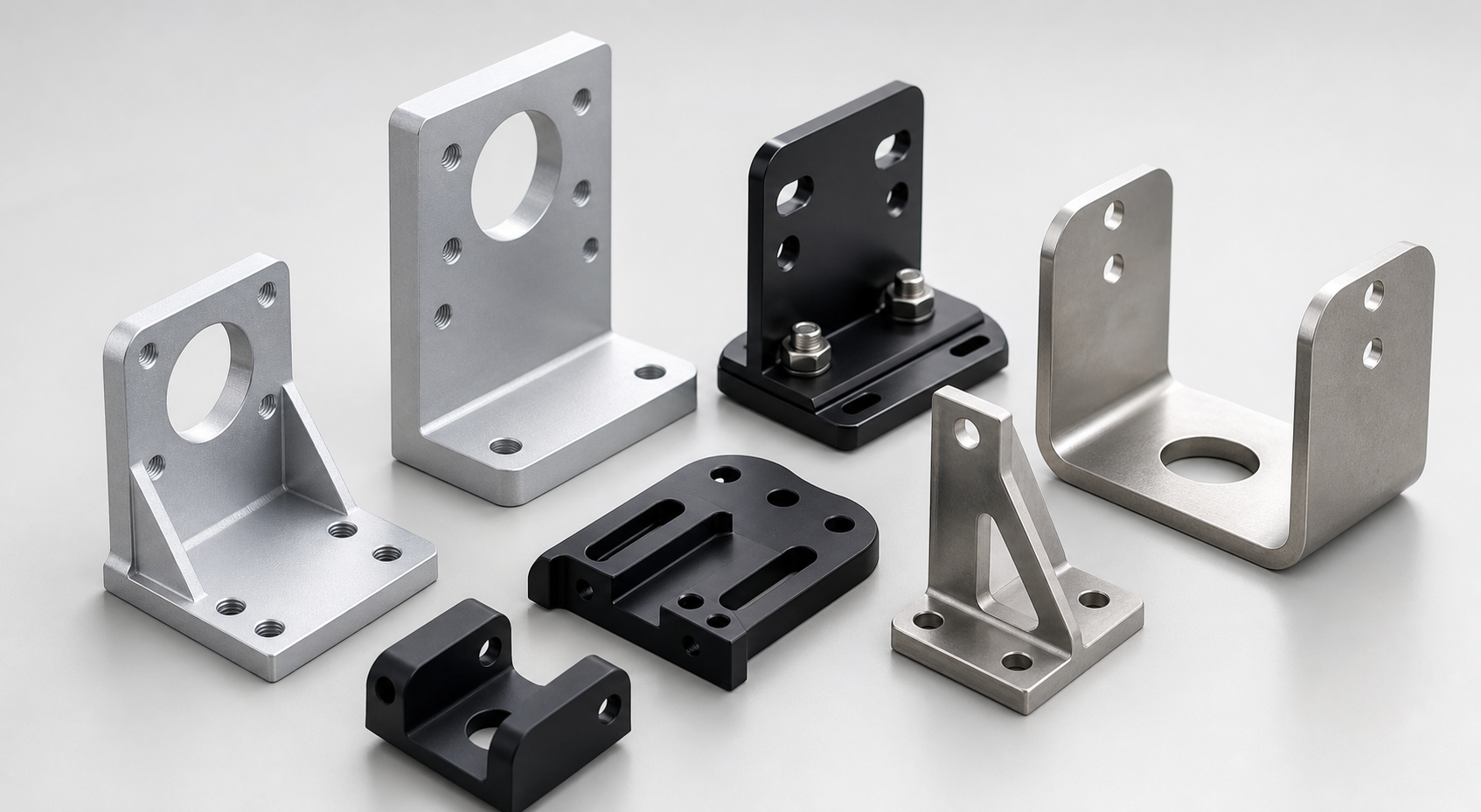
Sample custom bracket application patterns
These are shown as sample part patterns so buyers can match their own bracket program quickly.
Related bracket, housing and machining paths
Bracket projects often connect to housings, shafts, fixture plates, material selection and finishing. Use these related paths when the bracket belongs to a larger machined assembly or when material, finish and inspection decisions need to be reviewed together.
Frequently asked questions
What types of custom metal brackets are commonly quoted?
Common examples include L brackets, U brackets, Z brackets, gusset supports, mounting plates, tabs, capture brackets and offset mounts for industrial assemblies.
When is a bracket better machined than formed from sheet metal?
Machining is often preferred when the part needs thicker sections, tighter hole-to-face relationships, tapped features, counterbores, rigid gussets or faster prototype iteration without tooling.
Which materials are common for custom mounting brackets?
Aluminum, stainless steel and carbon steel are the most common choices. The right material depends on load, corrosion exposure, finish requirements and overall assembly weight, which is why custom aluminum brackets and custom steel brackets often split into different RFQ paths.
Which bracket features usually add the most cost?
Very thick stock, narrow slots, multiple tapped holes, multi-side machining, cosmetic faces and inspection-critical hole patterns usually add the most process time and cost.
What should be uploaded for a custom bracket RFQ?
Upload the CAD file or drawing together with material, thickness, finish, quantity, critical dimensions, mounting hardware notes and any inspection-document requirements.
Do bracket programs usually need FAI or dimensional reports?
Many do when the bracket controls alignment, supports a visible assembly or must repeat a critical hole pattern across mating parts in production.
Upload the bracket drawing with the mounting context
Custom brackets are easier to quote accurately when the drawing shows the mounting relationship, hardware callout, material, finish and any critical alignment dimensions. Use the RFQ page to submit the bracket package so geometry, finish and inspection expectations can be reviewed together.