Industrial Equipment Machined Parts for OEM Machinery Builds
Industrial equipment buyers do not need a generic machining promise. They need a supplier that understands machine structures, mounting interfaces, wear points, replacement schedules, document control and how industrial equipment machined parts will actually be installed on an OEM machine or production line.
Review the part types, materials, finishing paths and quality documents commonly requested for industrial equipment builds. Buyers comparing an OEM machinery parts supplier should show whether the project is for custom industrial machine parts, repeat replacement industrial machine components or broader industrial machinery CNC machining support. If the drawing package is ready, continue to Upload CAD for Quote. For broader machining capability, connect with CNC machining services, precision CNC machining and custom metal parts.
Industrial OEM RFQ essentials
- Machine function and whether the part is structural, wear-facing or alignment-critical
- Drawing revision, mating surfaces and critical fit points
- Material, finish and corrosion environment
- Prototype, pilot run, repeat production or replacement-part demand
- Any need for FAI, dimensional reports or material certs
- Target lead time, annual usage and destination country
| Primary CTA | Send industrial equipment RFQ |
| Best fit | OEM machine builders, automation integrators and repeat industrial equipment programs looking for machined parts for industrial equipment |
| Linked pages | Machining services, finish selection, inspection support and CAD upload |
Industrial machinery sourcing depends on part function, not just geometry
Industrial equipment buyers need more than a general CNC capability summary. A useful sourcing review separates commonly machined parts from plate or bar-stock components and identifies when the project may need casting, welding or secondary finishing support. That is the difference between a generic vendor search and a real OEM industrial equipment parts review.
Industrial equipment programs usually care about repeatability, mounting accuracy, service environment and controlled revision changes. The structure ties part families to process, material and document expectations instead of listing industries in the abstract.
- Structural machine parts need flatness, hole-position control and finish protection
- Wear-facing or moving parts often need better material and surface choices
- Replacement programs need revision discipline and repeat-order clarity
- Prototype builds and repeat OEM supply should be defined separately in the RFQ
Typical industrial equipment parts and how they are usually sourced
Before uploading a full project package, buyers usually want to know whether a supplier understands the part family, how it functions inside the machine and which process path is most realistic. This matters whether you are sourcing machined parts for industrial equipment, industrial automation machined components or custom CNC parts for equipment manufacturers.
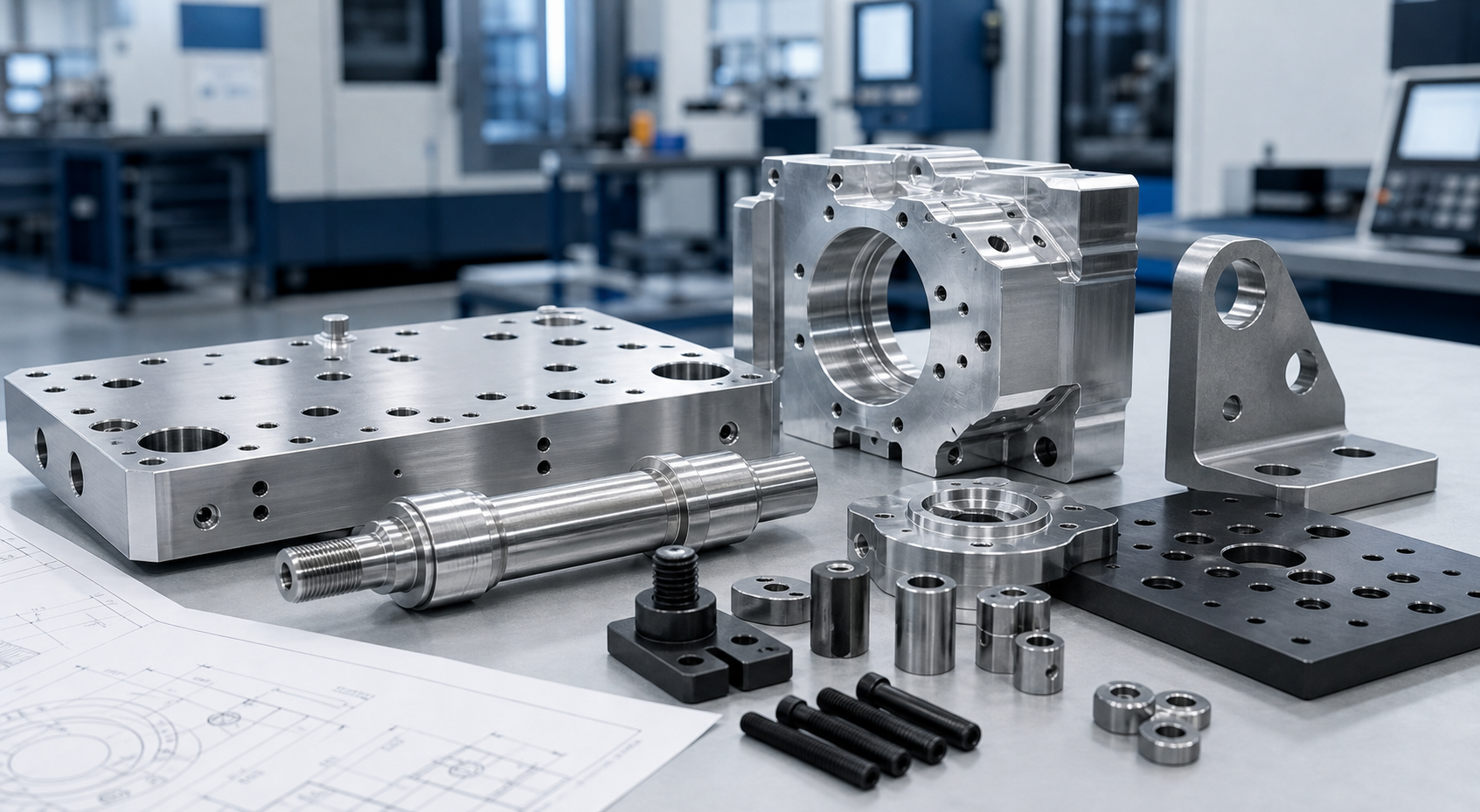
| Part family | Typical function | Common materials | Common process path |
|---|---|---|---|
| Base plates and machine plates | Mounting, stiffness, alignment and hole-position control | Aluminum 6061, carbon steel, stainless steel | Milling, drilling, tapping, deburring and optional coating |
| Brackets and mounting components | Interface support for sensors, guards, motors and subassemblies | Aluminum, steel, stainless steel | Milling or sheet-metal route depending on thickness and rigidity need |
| Housings and manifold blocks | Fluid routing, protection, internal pocketing and port interfaces | Aluminum, stainless steel, specialty alloys where needed | Milling, boring, tapping, sealing-surface review and inspection |
| Shafts, spacers and bearing seats | Rotational support, fit control and wear management | Steel, stainless steel, brass for selected bushings | Turning, grinding where needed and critical-diameter inspection |
| Fixtures and tooling plates | Assembly guidance, location control and repeat setup support | Aluminum, tool steel, steel plate | Milling, dowel-hole control, engraving or identification as required |
Material, process and finish choices for industrial machinery parts
Industrial equipment parts often fail when the sourcing logic is too simple. Geometry may machine cleanly, but the wrong material or finish can still create corrosion, galling, assembly-fit or maintenance problems. This is especially true for custom industrial machine parts that move from prototype into repeat field use.
Prototype, pilot run and repeat industrial supply are not the same job
Industrial OEM programs often move through several sourcing stages, and each stage changes what the supplier needs from the buyer.
- Prototype build: geometry, assembly-fit risks and manufacturability questions are still open
- Pilot run: the buyer starts checking revision control, dimensional consistency and document path
- Repeat production: annual usage, finish consistency, packaging and traceability become more important
- Replacement-part support: interchangeability and exact revision match matter more than exploratory DFM
A strong industrial-equipment RFQ should name the project stage from the start. That keeps the quote path aligned with the right review depth and document package for OEM industrial equipment parts and replacement industrial machine components.
What to include in an industrial equipment RFQ
- CAD model or drawing with current revision
- Part function inside the machine or equipment module
- Material, finish and corrosion or wear environment
- Prototype quantity, pilot quantity or repeat forecast
- Critical dimensions, assembly interfaces and fit notes
- Any need for inspection support, FAI or material certificates
- Packaging, destination country and target lead time
This gives the supplier enough context to quote the part as equipment hardware, not as isolated geometry, and helps an OEM machinery parts supplier screen revision, fit and document risk earlier.
Sample industrial equipment applications
These examples are shown as sample application patterns so OEM buyers can map their own equipment needs more quickly.
Related industrial equipment pathways
Industrial equipment programs often overlap with automation, energy, electronics, medical, aerospace and data-center hardware. Use these focused pages when the drawing package belongs to a more specific operating environment.
Frequently asked questions
What kinds of industrial equipment parts are commonly CNC machined?
Common examples include base plates, brackets, housings, manifold blocks, shafts, spacers, tooling plates and fit-critical machine details that need tighter control than stocked catalog parts provide.
When should a buyer use machined parts instead of standard purchased components?
Machined parts are typically used when geometry, fit, mounting pattern, material, service environment or machine integration cannot be covered by off-the-shelf hardware.
Which materials are most common for industrial machinery components?
Aluminum, carbon steel and stainless steel are common starting points. The final choice depends on stiffness, corrosion exposure, wear, cleaning environment and weight targets.
Do industrial equipment parts usually need FAI or dimensional reports?
Many do, especially when the part controls alignment, assembly fit or repeat interchangeability. Buyers should call out any first-piece approval or inspection-report requirement in the RFQ.
What should be uploaded for an industrial equipment part quote?
Upload the drawing or CAD model together with part function, material, quantity, finish, critical dimensions, project stage and any required quality documents. That prevents a generic quote on a machine-specific part.
Can Great Material support both new OEM builds and replacement-part programs?
Yes, but the RFQ should state which case applies. New builds often need more DFM discussion, while replacement programs usually focus on exact revision match, repeatability and document control.
Send the drawing package with the machine context
Industrial equipment parts should be quoted with function, material, finish and project-stage context, not as standalone geometry. Upload the drawing package through the RFQ page so the machining, inspection and document path can be aligned from the start for industrial equipment machined parts and repeat OEM machinery builds.