ELECTRONICS & HEAT SINK PARTS
CNC Machined Heat Sink and Electronics Thermal Parts for Aluminum Housings, Cooling Plates and Finned Components
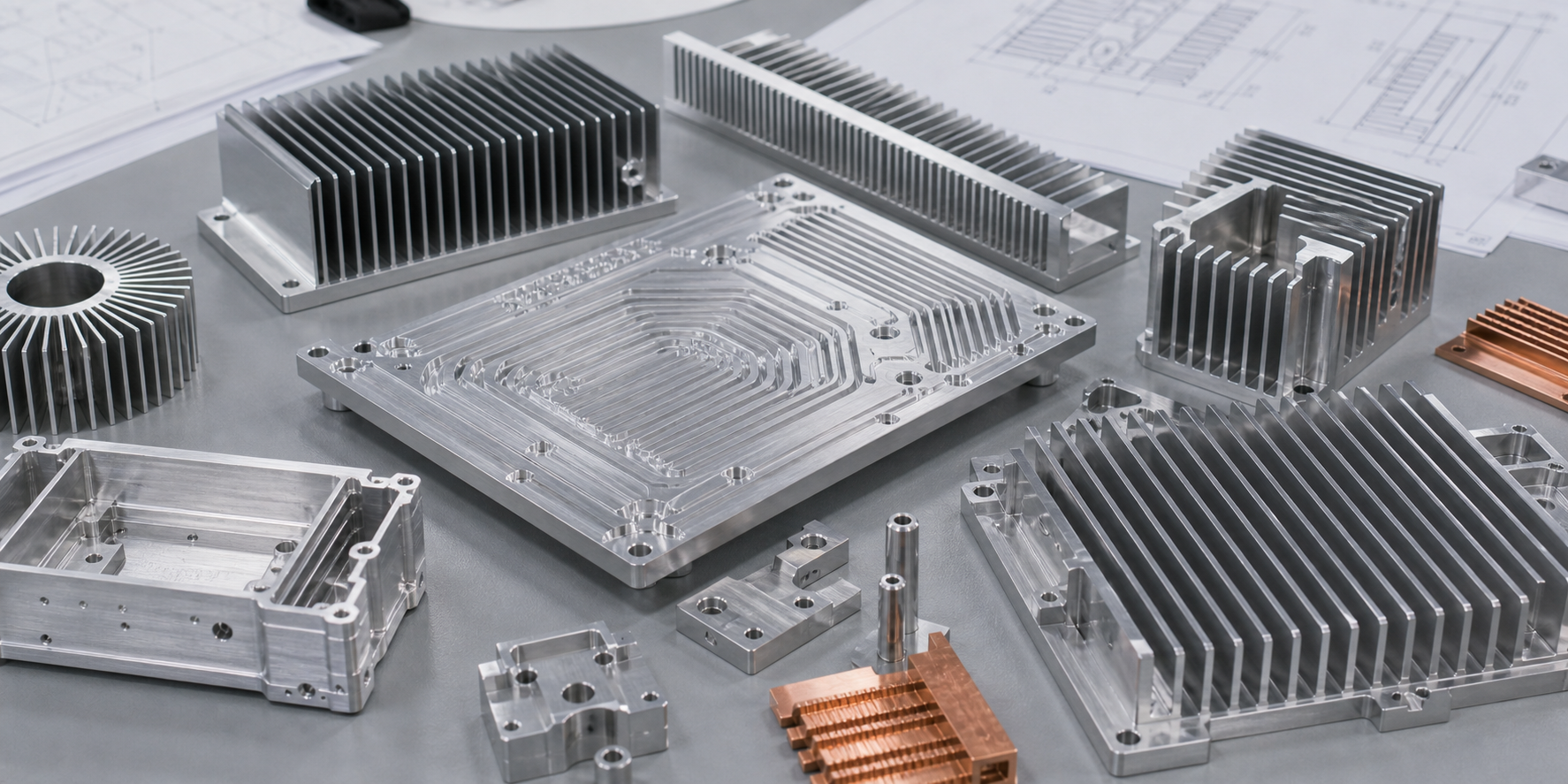
Electronics buyers sourcing thermal hardware are often not looking for generic aluminum parts. They are evaluating machined heat sinks, cooling plates, finned housings, base plates and enclosure components that must support thermal contact, assembly fit and repeatable mounting features.
Engineers and buyers can classify machined heat sink families, choose aluminum material and finish routes, and prepare the details needed before prototype or low-volume RFQ review. When the design is ready, continue to Request a Quote. For supporting capability paths, connect with aluminum CNC machining, precision CNC machining, surface finishing for CNC parts and machined housings and enclosures.
Heat sink RFQ essentials
- Part role: heat sink, cooling plate, finned housing, base plate or electronics enclosure hardware
- Critical faces, thermal contact surfaces, fin geometry, tapped holes and mounting datums
- Material route such as 6061, 6063 or enclosure-grade aluminum
- Required finish such as clear or black anodize, bead blast or bare machined surface
- Prototype quantity, low-volume build stage and assembly context
- Any need for inspection support, dimensional report or special documentation
| Primary CTA | Send heat sink design |
| Best fit | Thermal design teams, electronics hardware buyers and prototype sourcing groups |
| Linked pages | Aluminum machining, precision machining, housings, finishing and RFQ upload |

Thermal hardware is usually judged by contact surfaces, fins and assembly geometry together
The better competitor pages explain heat sink manufacturing routes, but many still leave the buyer with a gap between thermal design intent and a quotable CNC part. A finned heat sink, a cooling plate and a machined enclosure base do not carry the same machining priorities even when all are aluminum thermal parts.
That is why the guide groups electronics thermal hardware by part family first. The goal is to help buyers define the correct material, finish and critical faces before the RFQ is reviewed.
- Heat sinks often depend on fin geometry, flat base faces and tapped assembly features
- Cooling plates add interface control, channel features and flat thermal contact areas
- Finned housings and enclosures combine structural fit with thermal-management requirements
- Prototype thermal parts benefit from clear drawing revision and finish selection before quoting
Typical heat sink and electronics thermal parts that fit CNC machining well
This matrix helps buyers separate common thermal hardware types by role and machining concern.
| Thermal part family | Typical role | Common materials | Key machining concern |
|---|---|---|---|
| Machined heat sinks | Dissipate heat from electronics assemblies through fins and flat contact areas | Aluminum 6061, 6063 | Fin spacing, fin height, flat mounting face and tapped assembly features |
| Cooling plates and thermal base plates | Provide thermal contact, spreading and mounting support for power electronics or LED systems | Aluminum, copper-assisted or insert-based assemblies | Flatness, channel features, interface control and thread integrity |
| Finned housings and electronics enclosures | Combine enclosure structure with thermal dissipation surfaces | Aluminum 6061, enclosure-grade aluminum | Wall control, fin geometry, sealing grooves and mating alignment |
| LED and compact thermal mounts | Support compact devices where thermal contact and mounting accuracy matter together | Aluminum, selective copper inserts | Local flatness, hole position and contact-surface repeatability |
| Prototype thermal hardware sets | Validate thermal and mechanical design before wider low-volume builds | Material selected by thermal route and assembly context | Revision flexibility, quick updates and finish coordination |
Material and finish choices for heat sinks and thermal enclosures
Most thermal hardware decisions are not just about using aluminum. Buyers also need to think about fin geometry, contact surfaces, surface finish, thread life and enclosure assembly behavior.
Related process planning often connects to aluminum CNC machining and surface finishing for CNC parts.
When CNC machining fits better than a generic heat sink route
A buyer comparing thermal-part suppliers is often deciding between a standard profile route and a more custom machined route. CNC machining becomes more useful when the part is not only a simple fin profile but also needs threaded features, mounting datums, housing geometry, sealing features or tight face control.
- Prototype thermal parts benefit from fast geometry changes and controlled interface features
- Cooling plates and enclosure bases often need more than simple fin stock can provide
- Custom mounting patterns, tapped holes and local pockets make machining more relevant
- Low-volume builds often prioritize design fidelity over the simplest commodity route
That is where precision CNC machining, inspection support and a complete RFQ package help thermal parts move faster from concept to low-volume supply.
Prototype to low-volume thermal part workflow
- Prototype thermal hardware: validate fin logic, contact faces and enclosure fit
- Pre-build refinement: tighten mounting patterns, face control and finish assumptions
- Low-volume supply: stabilize revision control, inspection scope and part-to-part consistency
This structure keeps the page aligned with how thermal hardware is actually reviewed before purchase.
What to include in a heat sink or thermal hardware RFQ
| RFQ input | What to include |
|---|---|
| CAD model and drawing | Upload the current revision with fin geometry, contact faces, tapped holes, pockets, grooves and mounting relationships defined. |
| Thermal part role | State whether the part is a heat sink, cooling plate, finned housing, base plate or electronics enclosure component. |
| Material and finish | Call out 6061, 6063 or other thermal material routes plus anodizing, blasting or bare contact-surface requirements. |
| Build stage | Clarify prototype or low-volume demand so review priorities match the actual program stage. |
| Critical faces and features | Identify thermal contact surfaces, local flatness needs, fin areas, thread features and mating geometry early. |
| Project notes | Add assembly context, destination, timeline and any special inspection or packaging concerns. |
Frequently asked questions
What electronic heat sink parts are commonly CNC machined?
Common examples include machined heat sinks, cooling plates, finned housings, base plates, thermal enclosures and electronics mounting parts with thermal contact faces.
What aluminum grades are common for machined heat sinks?
6061 and 6063 are common starting points, with the final choice depending on fin geometry, enclosure design, finish route and overall part function.
When is CNC machining better than a basic extrusion route?
Machining becomes more useful when the part needs custom mounting patterns, tapped holes, pockets, enclosure geometry, sealing details or controlled thermal contact surfaces.
What tolerances matter for machined heat sinks?
The most important controls are usually flat thermal mounting faces, fin consistency where relevant, tapped feature quality and repeat mounting geometry.
Can CNC machining support prototype and low-volume thermal parts?
Yes. CNC machining is commonly used when thermal hardware needs design flexibility, controlled features and a practical route from prototype into low-volume supply.
What should be included in a heat sink RFQ?
Include the current drawing revision, part role, material grade, finish, critical thermal faces, mounting features, quantity and any inspection or packaging notes.
Quote the thermal part together with the contact faces, fins and finish logic
Heat sinks and electronics thermal parts should be quoted with the right material, finish and critical mounting geometry already defined. Use the RFQ page to submit the drawing package so machining, finishing and inspection decisions can be aligned early.