STAINLESS FINISH SELECTION
Stainless Steel Passivation
Passivation is used on stainless steel parts to remove free iron and restore a stronger chromium-rich oxide film after machining, handling and fabrication. It improves corrosion resistance without adding a visible coating or meaningfully changing part dimensions.
Built for buyers and engineers reviewing passivation for machined stainless components, this finish guide covers the decision points that affect quoting and release. It covers ASTM guidance, citric versus nitric routes, when passivation is enough, when pickling or electropolishing is the better fit, and what to note before quote review. For the broader finish path, connect with surface finishing for CNC parts, stainless steel CNC machining, quality control and inspection and Request a Quote.
Fast finish check
- Use passivation when stainless parts need stronger corrosion resistance after machining without adding thickness
- Use electropolishing when surface smoothness and easier cleanability matter alongside corrosion resistance
- Use pickling when heat tint, oxide scale or heavier surface contamination must be removed first
- Include alloy grade, finish standard and any document request in the RFQ so finish review is faster
| Primary CTA | Add passivation to quote |
| Best fit | Machined stainless housings, fittings, shafts, fasteners and medical or industrial parts |
| Key decisions | Standard, citric vs nitric route, appearance expectations and whether pickling or electropolishing is also needed |

Why passivation is specified after stainless steel machining
Stainless steel already forms its own passive oxide layer, but machining, handling and shop contamination can leave free iron, residue or embedded particles on the surface. Passivation removes that contamination and helps the stainless surface recover a more corrosion-resistant condition.
That is why passivation is commonly reviewed on stainless parts used in medical, industrial, marine-adjacent, chemical handling and general outdoor environments. It is especially useful when the part should keep its metallic appearance and fit dimensions instead of receiving a paint or plated coating.
- Passivation is non-additive, so it does not behave like a coating buildup
- It is often called out after machining for fittings, valves, shafts, fasteners, brackets and housings
- It improves corrosion resistance, but it is not the same as removing heat tint or oxide scale
- Standard and route selection should be reviewed with the alloy grade and final application
Passivation vs electropolishing vs pickling for stainless parts
This comparison is written for drawing review and finish selection, not just finish terminology.
| Decision factor | Passivation | Electropolishing | Pickling |
|---|---|---|---|
| Primary purpose | Remove free iron and restore a stronger passive surface on stainless | Smooth and brighten the surface while also improving corrosion resistance | Remove heat tint, scale and heavier oxide contamination before or instead of passivation |
| Visual effect | Little to no visible change when done correctly | Brighter, smoother, cleaner cosmetic result | More aggressive cleaning step, usually not chosen for cosmetic refinement alone |
| Dimensional impact | Minimal and typically preferred for fit-sensitive stainless parts | Removes a thin amount of material and should be reviewed for critical geometry | More aggressive than passivation and should be planned carefully |
| Best fit | General machined stainless parts needing corrosion improvement without coating | Medical, sanitary or clean-flow parts where finish smoothness matters | Welded or heat-affected parts with scale or tint that simple passivation will not solve |
| RFQ implication | Call out standard, alloy and any cleanliness or report requirement | Call out cosmetic intent, cleanability and any surface roughness target | Call out heat tint or scale condition and whether another finish follows after cleaning |
Citric or nitric passivation is not just a chemistry question
The route is usually selected around alloy behavior, environmental preference, customer specification and process control. Citric chemistry is often chosen where environmental and handling preferences matter, while nitric-based routes remain common where established specifications or legacy process control requirements already exist.
Citric route
Often selected when buyers want a well-known stainless passivation route with a cleaner environmental profile and no added coating thickness.
Nitric route
Often selected where established specifications, prior approvals or alloy-specific process history already point to a nitric-based route.
What to specify
State the alloy, standard or customer note, whether appearance matters, and whether the part arrives with weld tint, scale or contamination that may require a stronger pre-cleaning step.
Which stainless parts and grades are most often reviewed for passivation
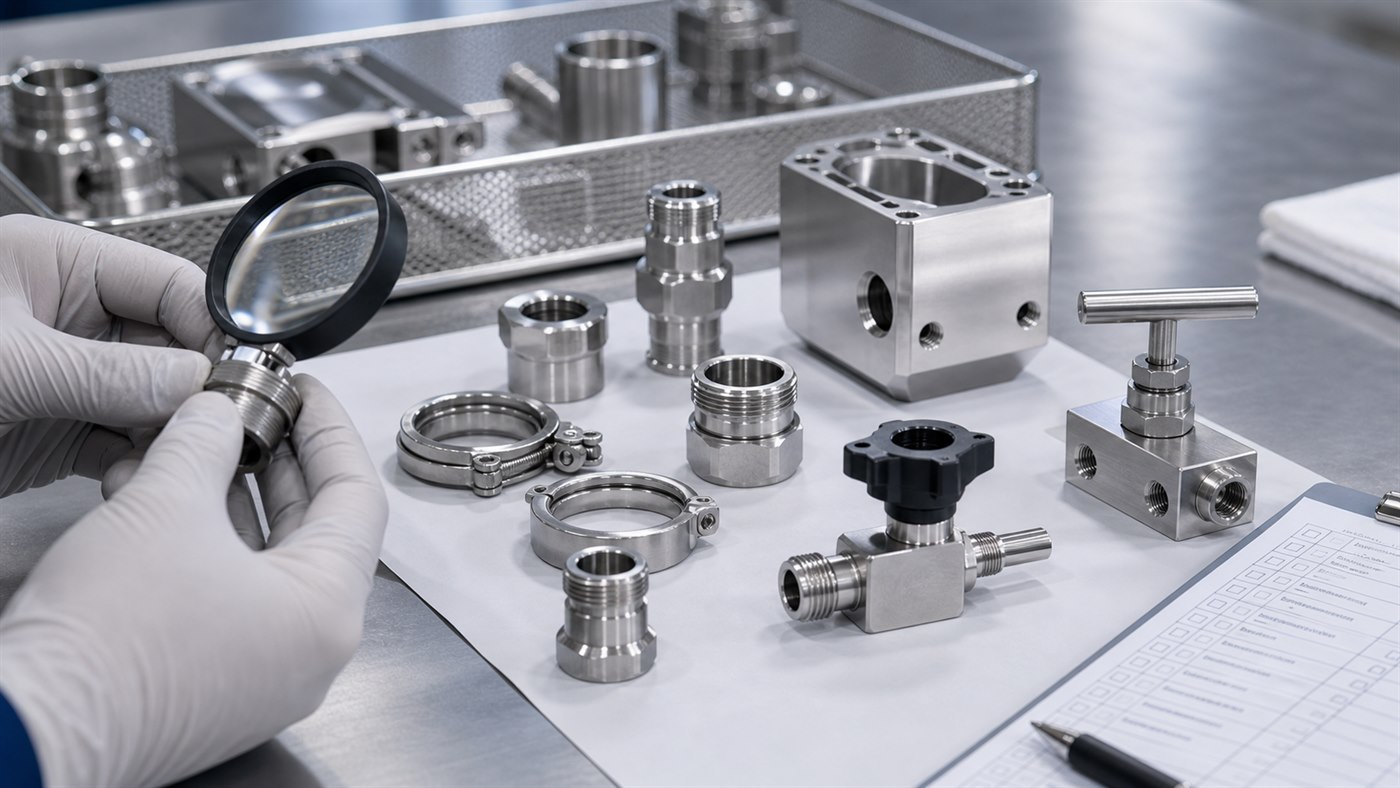
Passivation is most often reviewed on corrosion-sensitive stainless parts that have been machined, handled, assembled or exposed to shop contamination before delivery. Common examples include shafts, threaded fittings, small valve bodies, brackets, sensor housings, medical parts and instrumentation hardware.
| Grade | Typical passivation fit | Part examples | Review note |
|---|---|---|---|
| 303 | Used when machinability is important and corrosion protection still matters | Turned fittings, small shafts, instrument details | Confirm final environment because grade selection still matters beyond finish choice |
| 304 / 304L | Common all-purpose passivated stainless route | Covers, housings, brackets, food-contact-adjacent parts | Call out passivation when post-machining contamination or environment makes it worthwhile |
| 316 / 316L | Common for harsher corrosion environments and cleaner applications | Medical hardware, marine-adjacent components, process equipment details | Often paired with cleanliness or document expectations |
| 17-4 PH | Used on higher-strength stainless parts that still need improved corrosion resistance | Aerospace, industrial and motion hardware | Review heat treatment state and customer finish notes together |
For alloy choice before finish selection, connect with stainless steel CNC machining, 304 vs 316 stainless steel and material certificates and traceability.
What to include in a passivation RFQ
- Part drawing and CAD with any finish note already marked
- Stainless grade and condition, such as 304, 316L or 17-4 PH
- Whether the part is machined only or also welded, scaled or heat tinted
- Whether appearance must stay natural or whether a brighter finish is desired
- Any requested standard, document package or inspection report
- Destination environment if corrosion exposure is the main reason for the finish
If the part needs smoother sanitary surfaces rather than simple contamination removal, ask whether electropolishing should be reviewed instead.
Frequently asked questions
What does passivation do to stainless steel parts?
It removes free iron and contamination from the surface so the stainless part can restore a stronger passive oxide condition and improve corrosion resistance.
Does passivation change part dimensions?
It is generally chosen because it is non-additive and does not behave like a coating buildup. That makes it suitable for many fit-sensitive machined stainless parts.
Can passivation remove heat tint or oxide scale?
Not reliably. If welded stainless arrives with heat tint or heavier oxide scale, pickling or another stronger cleaning route may need to be reviewed first.
How do citric and nitric passivation differ?
Both are used to remove surface contamination and support passivation. The route is usually selected around specification, alloy behavior, process history and environmental preference.
When is electropolishing better than passivation?
Electropolishing is the better review path when the part also needs a smoother, brighter and easier-to-clean surface rather than mainly corrosion improvement after machining.
What should be written on the drawing or RFQ?
Call out the stainless grade, the requested finish standard or customer note, any cleanliness or appearance expectations, and whether inspection or documentation should be included.
Add the Stainless Grade, Finish Standard and Corrosion Requirement to the RFQ
If passivation is part of the finish route, send the drawing package with alloy grade, passivation note and any document request. Use the RFQ page to connect finish review with first article inspection, material certificates and the final quote path.